
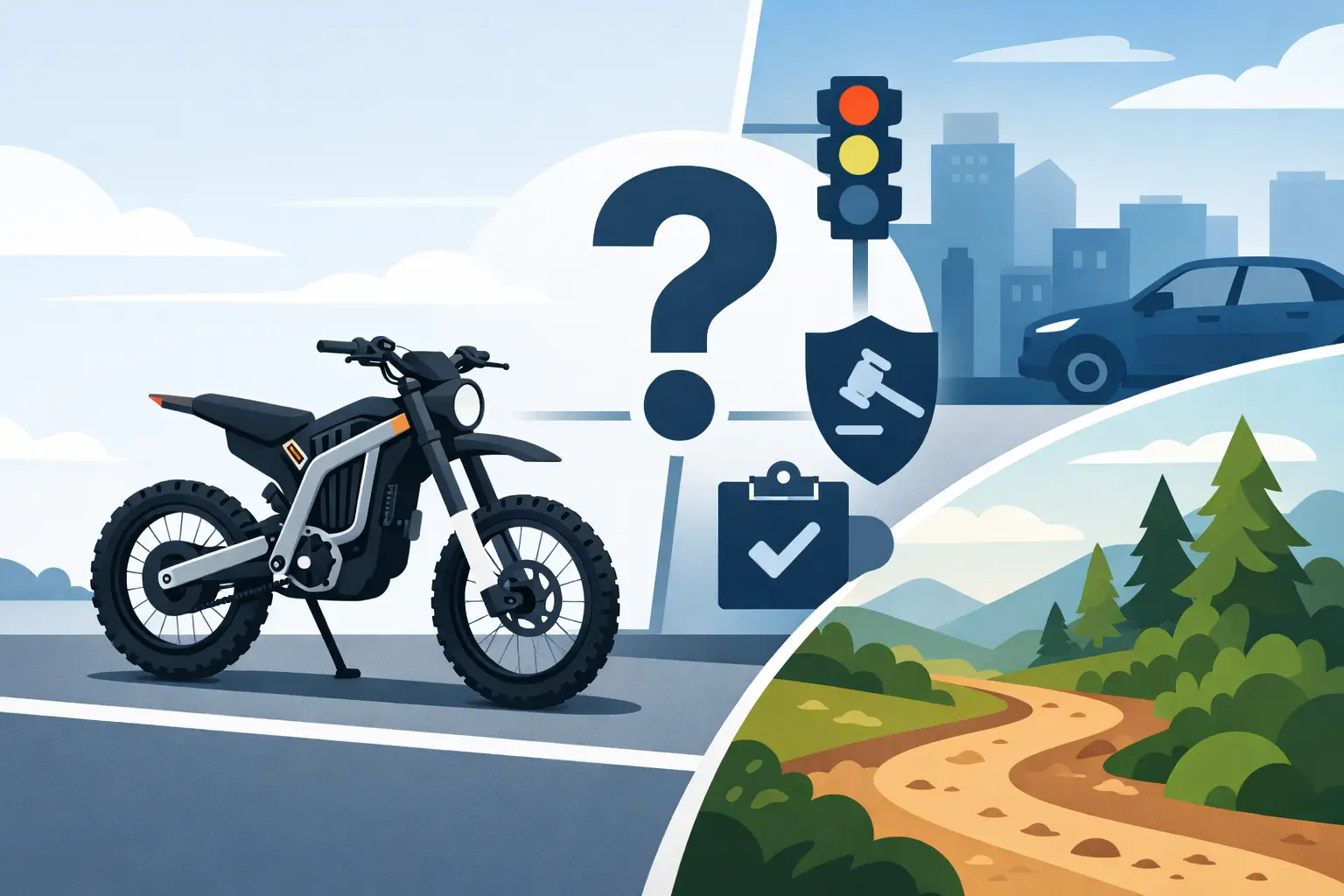
A lot of riders see the Sur-Ron Light Bee and ask the same thing right away – can I actually ride this thing on the street? If you’re searching for whether the light bee l1e street legal status is real, the short answer is yes, but only when you’re talking about the L1E version and only when your local rules line up with how the bike is registered, equipped, and used.
That distinction matters. The Light Bee platform has serious crossover appeal because it feels far more exciting than a typical commuter, yet a lot more approachable than a full-size motorcycle. For riders who want electric power, compact size, and real-world versatility, the L1E version is the one built for that dual-purpose role.
What makes the Light Bee L1E street legal?
The big difference is that the Light Bee L1E is designed as the road-homologated version of the platform. In plain English, that means it’s the model built with street use in mind, not just off-road fun. Depending on market configuration, that usually includes the lighting, mirrors, signals, plate mount, and other road equipment needed for registration.
That does not mean every Light Bee is automatically street legal just because it looks similar. Riders get tripped up here all the time. A Light Bee X and a Light Bee L1E may share the same aggressive Sur-Ron DNA, but they are not the same thing when it comes to legal road use.
If you want pavement access without guessing, the L1E is the version you should be focused on. It gives you the strongest starting point because it was built to cross over between urban riding and light trail use, rather than forcing an off-road model into a legal gray area.
Light Bee L1E street legal status depends on your state
Here’s where things get real. In the US, street legal status is never just about the bike itself. It also depends on your state DMV, your local equipment standards, registration category, and in some places your insurance requirements.
Some states may treat a bike like the Light Bee L1E more like a moped or low-power motorcycle, while others may classify it differently based on top speed, motor output, VIN documentation, and required equipment. That means a setup that works smoothly in one state may need extra paperwork or may not qualify the same way in another.
For riders chasing the best of both worlds, this is the trade-off. The L1E gives you a much better legal path than a pure off-road version, but it does not erase state-by-state variation. If you want zero surprises, check your local registration rules before you buy or ride.
What to check before you ride on public roads
If your goal is street use, you need more than confidence. You need confirmation. Start with the basics: title or certificate of origin, VIN documentation, bill of sale, and any manufacturer paperwork that supports on-road classification.
Then look at the bike itself. A road-legal setup typically means functioning headlight, taillight, brake light, turn signals, mirrors, horn, and a mount for a license plate. Tires also matter. If your bike is wearing aggressive off-road rubber that is not approved for road use, that can create problems even if the bike itself qualifies.
You should also verify age, license, helmet, and insurance requirements in your state. Some riders assume electric means easier rules. Sometimes it does, sometimes it does not. The smart move is to treat the L1E like a serious machine and confirm every box before you hit public streets.
Why riders want the Light Bee L1E in the first place
The appeal is obvious the first time you throw a leg over one. The Light Bee L1E is compact, quick, and ridiculously fun, but it also has practical range for short commuting, neighborhood runs, and backroad riding. It feels lighter and more playful than a lot of small motorcycles, yet it still delivers the instant torque that makes electric riding addictive.
For newer riders, that lighter footprint can be a huge advantage. It’s less intimidating than a full-size gas bike, easier to maneuver, and much easier to live with if you’re working with limited space. For experienced riders, it’s a blank canvas with attitude – nimble enough for urban movement, capable enough for dirt detours, and loaded with upgrade potential.
That mix is exactly why the street legal question keeps coming up. Riders do not just want another e-bike. They want something that looks sharp, hits hard, and still has a path to legal road use.
Street legal does not mean highway ready
This is one of the biggest misunderstandings around the platform. Even if the Light Bee L1E is street legal in your area, that does not mean it belongs on every road. Legal access and practical use are two different things.
The L1E shines in city streets, side roads, mixed-use riding, and shorter commutes where agility matters more than sustained top speed. It’s a killer option for riders who want to cut through traffic, handle rough pavement, and still enjoy the ride. But if your daily route includes long high-speed highway stretches, you may want something larger and more road-focused.
That is not a weakness. It’s just using the machine for what it does best. The Light Bee L1E wins on responsiveness, fun factor, lighter handling, and low operating hassle. It is not trying to be a touring bike.
How the L1E compares to off-road-only Sur-Ron models
If you are deciding between a Light Bee L1E and an off-road Sur-Ron, your riding style should make the choice for you. If most of your time will be on trails, private land, or closed courses, an off-road configuration may be the better fit. You can skip some of the road-focused gear and stay locked in on dirt performance.
But if you want one machine that can handle urban use, errands, back streets, and occasional off-road sessions, the L1E has a clear edge. It gives you more flexibility from day one. That matters for riders who want a bike they can actually use often, not just on weekends.
There’s also a value angle here. A bike with street-ready capability can open up more use cases, which makes ownership easier to justify. You’re not buying a toy that only comes out for trail days. You’re buying a machine that can fit real life and still deliver the thrill.
Upgrades can affect your legal setup
Performance upgrades are part of the fun with Sur-Ron ownership. Riders want more power, more range, sharper controls, better tires, stronger brakes, and custom style. That is part of what makes the platform so addictive.
But there is a catch. If you push the bike far beyond its original configuration, especially with powertrain changes, you may affect how it fits local street-use rules. A controller swap, battery upgrade, or speed-unlocking setup can be a blast off-road, but it may complicate the legal picture if your state has specific classification limits.
That does not mean you should not upgrade. It means you should upgrade with a plan. If street use is part of your goal, keep legal compliance in mind before turning the bike into a full custom build.
Who the Light Bee L1E is best for
The L1E makes a ton of sense for riders who want excitement without the bulk of a traditional motorcycle. It fits commuters who are bored of ordinary transport, weekend riders who want more freedom, and new electric riders who want a machine with real performance but manageable size.
It also works for budget-conscious buyers who want one platform they can grow into. Start with a capable street-ready machine, ride it stock, then upgrade over time as your skills and goals evolve. That path is a lot more appealing than buying the wrong bike first and replacing it later.
For riders shopping with performance on the brain, this is where a specialist retailer matters. A focused Sur-Ron source like SurronBikesZone makes it easier to match the right model with the right parts, accessories, and upgrade path instead of piecing everything together across random shops.
Should you buy a Light Bee L1E for street riding?
If your state allows it and the bike is properly equipped and registered, the answer is strong yes. The Light Bee L1E brings serious electric fun to a category that often feels either too tame or too bulky. It has the right energy for riders who want nimble handling, instant torque, and a machine that can move between practical use and pure fun.
Just keep your expectations sharp. Street legal is not universal, and it is not automatic. The smartest buyers treat the L1E like what it is – a high-performance electric machine with huge crossover potential, plus a legal checklist that needs to be handled correctly.
Get that part right, and you end up with one of the most exciting ways to ride short to medium distances on two wheels. If you want a bike that feels alive every time you twist the throttle, the Light Bee L1E is worth a serious look.