

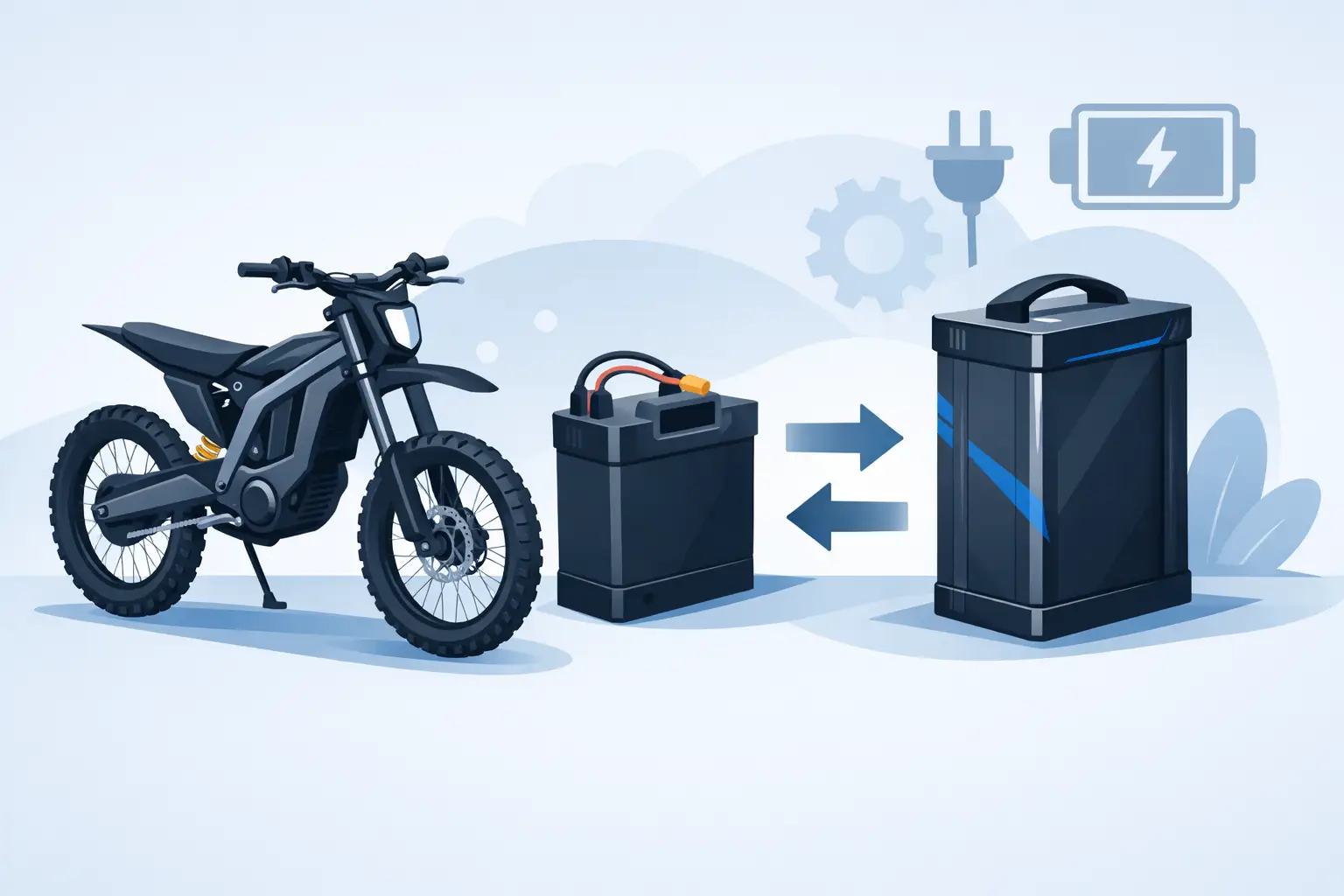
Your Sur-Ron feels fast right up until it doesn’t. The first time you hit a long climb, run hard through a full afternoon, or ask for more punch out of corners, the stock setup starts showing its ceiling. That is exactly when a sur ron battery upgrade moves from a nice idea to a serious performance decision.
For a lot of riders, battery upgrades get talked about like a magic fix. More volts, more amp hours, more power – done. Real life is a little more interesting than that. The right battery can wake the bike up in a big way, but only if it matches how you ride, what controller you run, and what you expect from the bike when the trail gets rough or the street opens up.
When a sur ron battery upgrade actually makes sense
If you mostly cruise short distances, ride mellow terrain, and charge after every session, a stock battery may still be doing its job. Not every rider needs to spend big just because upgrade talk is everywhere. But if your bike feels like it runs out of breath too early, range is holding back your rides, or you have already started stacking performance mods, the battery becomes the bottleneck fast.
This is especially true for riders on the Light Bee platform who want stronger acceleration, better sustained output, and less voltage sag under load. A battery upgrade is not just about top speed. It changes how the bike delivers power across the ride. That means harder pulls, more consistent performance when the pack drains, and a ride that feels stronger instead of softer after the first burst.
For commuters and dual-use riders, the value can be different. You may care less about peak hit and more about dependable range, faster recharge habits, or reducing the anxiety of showing up nearly empty. In that case, capacity and battery quality matter more than bragging rights.
What changes when you upgrade the battery
The biggest shift is usually in power delivery. A higher-performance battery can support more current, which helps the bike accelerate harder and maintain output when you are pushing it. Instead of feeling sharp for a moment and then fading, the bike stays more alive deeper into the ride.
Range can improve too, but it depends on your right wrist. Many riders upgrade, enjoy the extra power, and immediately start riding harder. That can erase some of the range gain. If you ride at the same pace as before, a larger-capacity battery usually gives you more miles. If you use the upgrade as an excuse to go full attack mode, expect performance to rise faster than efficiency.
Charging behavior also matters. Some upgraded packs support faster charging setups, but faster is not automatically better if it adds heat or shortens long-term battery life. Riders who want maximum convenience should think about charging speed as part of the package, not the only headline spec.
Voltage vs amp hours: what matters more?
This is where a lot of buyers get tripped up. Higher voltage often means a more aggressive jump in performance, especially when paired with the right controller. That is the route riders take when they want a bike that feels dramatically stronger and more responsive.
Amp hours are more about capacity. Bigger amp-hour ratings typically point toward longer runtime, assuming similar riding conditions. If your main complaint is that your rides end too soon, capacity deserves attention. If your main complaint is that the bike feels flat, voltage and discharge capability deserve more attention.
Neither number tells the whole story on its own. Cell quality, battery management system design, heat handling, pack construction, and controller compatibility all matter. A battery that looks huge on paper but is poorly built can become an expensive headache. A well-built pack with proven cells and clean fitment is usually the smarter play than chasing the most inflated spec sheet.
Choosing the right sur ron battery upgrade for your riding style
Trail riders usually want balance. Enough extra power to make climbs, technical sections, and long loops more fun, but not so much that the bike becomes twitchy or drains too quickly. For this kind of rider, a well-matched battery and controller combo often beats the biggest battery possible.
Urban riders and commuters tend to value range, recharge convenience, and predictable output. If you ride to work, around town, or between mixed surfaces, a stable, durable pack with solid everyday usability makes more sense than a race-focused setup.
Performance chasers are looking for a different result. If your goal is harder launches, stronger roll-on power, and a bike that feels radically more aggressive, your battery choice needs to support high demand. That usually means thinking beyond the battery alone and planning for controller, wiring, and drivetrain stress too.
Budget matters here as well. A battery upgrade is one of the most exciting changes you can make, but it is also one of the most expensive. Some riders are better off improving tires, brakes, or suspension first, then circling back to battery power once the rest of the bike is ready for it.
Don’t ignore controller compatibility
This is where smart builds separate themselves from rushed ones. A battery can only deliver its full benefit if the controller is built to use it properly. Put a high-performance battery on a stock controller and you may get some improvement, but not the full hit you expected.
Go too far the other way and you can create reliability issues. If the battery, controller, motor, and wiring are not aligned, you are putting stress into the system whether you notice it immediately or not. Heat, cutouts, poor tuning, and reduced component life can show up later.
For riders building toward serious output, the battery upgrade should be part of a package, not a one-part gamble. That means checking voltage support, current handling, connector quality, charger compatibility, and whether your bike’s setup is actually ready for the jump.
Fitment, weight, and real-world durability
Not every upgraded pack behaves the same once the ride gets rough. A battery might offer big numbers but create fitment headaches, awkward mounting, or extra weight that changes how the bike handles. That matters more than many buyers expect.
A heavier pack can affect agility, especially on technical trails where quick direction changes matter. For some riders, the extra power and range are worth that trade-off. For others, preserving the bike’s playful feel is just as important as adding output.
Durability matters just as much. Off-road riders need a pack that can handle vibration, heat, and repeated abuse. Build quality is not a bonus feature. It is part of performance. If a battery is going to live on a bike that gets ridden hard, it needs to be ready for real use, not just a clean spec sheet.
Is the upgrade worth the money?
Usually, yes – if your riding goals have outgrown the stock setup. A strong battery upgrade can transform how a Sur-Ron feels, and for many riders it becomes the mod that finally makes the bike match the hype in their head.
But the value depends on what you want back. If you are chasing more excitement, stronger sustained power, and a bike that keeps pulling when the trail gets steep, the payoff can be huge. If your current battery still covers your typical rides and you are not demanding more from the bike, the return is smaller.
There is also the question of upgrade order. Some riders jump straight to battery power when their real issue is traction, braking confidence, or suspension control. More speed is thrilling, but only if the rest of the bike is ready to carry it. That is why the best upgrade path is rarely about one part in isolation.
At SurronBikesZone, that rider-first mindset matters. The best setup is not always the most extreme one. It is the one that fits your bike, your budget, and the kind of riding that keeps you coming back for one more lap.
The smartest way to decide
Start with the problem you are trying to solve. If it is weak range, shop for capacity and proven reliability. If it is soft performance, look at voltage, discharge capability, and controller pairing. If it is both, be ready to invest in a setup that supports the whole bike, not just one impressive number.
A sur ron battery upgrade should make your ride feel sharper, stronger, and more ready for the way you actually use it. That might mean more trail time, a harder hit off the line, or the confidence to ride farther without watching the battery percentage like a hawk.
The best upgrade is not the one that sounds wildest in a forum thread. It is the one that keeps delivering when the terrain gets rough, the throttle stays open, and you want every ride to feel like the bike is finally running at full charge.